

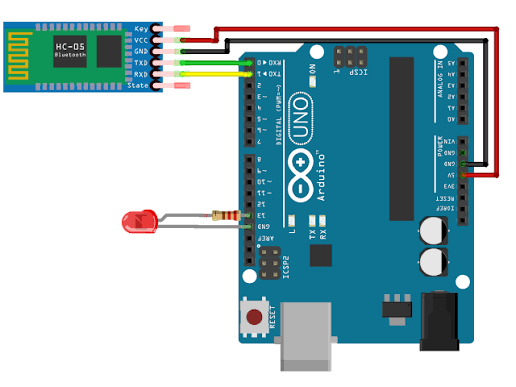
Control an LED wirelessly using voice commands sent from a smartphone through Bluetooth. This introduces students to wireless control and smart-home applications, such as controlling lights, fans, and other devices remotely.
What You Will Learn
Serial communication over Bluetooth (HC-05)
Parsing single-character commands
Controlling two motors independently
Pairing and using a Bluetooth controller app
Components Required
Arduino UNO R3HC-05 Bluetooth Module5mm LED220Ω Resistor1kΩ Resistor2kΩ ResistorBreadboardJumper Wires
BUILD IT STEP BY STEP
Follow along and build with confidence.
Every step includes a visual reference and a plain-language explanation, so you always know what to do next.
STEP 01
Upload the Code
💻
This sketch listens for single-character commands over Bluetooth serial: F (forward), B (backward), L (left), R (right) and S (stop).
Ensure the HC-05 is powered and its LED is blinking (searching mode); some modules need a first-time pairing directly from phone Bluetooth settings.
Car doesn't respond to commands.
Check TXD/RXD aren't swapped, and temporarily disconnect the HC-05 while uploading new code, since it shares the same serial pins as USB upload.
Car only goes forward, other commands don't work.
Confirm your controller app is sending single characters (F, B, L, R, S) and not full words or line-ending characters the switch statement doesn't expect.
WANT GUIDED, HANDS-ON HELP?
Bring this project to life with a mentor.
Loved building this for free? Our instructor-led workshops go deeper with kits, live guidance and more advanced builds.
Learn how to control an LED using Arduino UNO by making it turn ON and OFF automatically. This is the basic concept behind indicator lights, warning lights, and signal systems used in real-world electronic devices.
Use a PIR sensor to detect human movement and automatically switch ON an LED. This demonstrates the technology used in security systems, automatic lights, smart homes, and occupancy detection.
Build a smart street light that automatically turns ON when it gets dark and OFF during daylight using an LDR sensor. This concept is commonly used in street lights, garden lights, parking areas, and energy-saving lighting systems.